I SEE
Scanning & awareness
One Touch lyric
“You watch the ball, I watch the space.”
What did you see before the ball arrived?
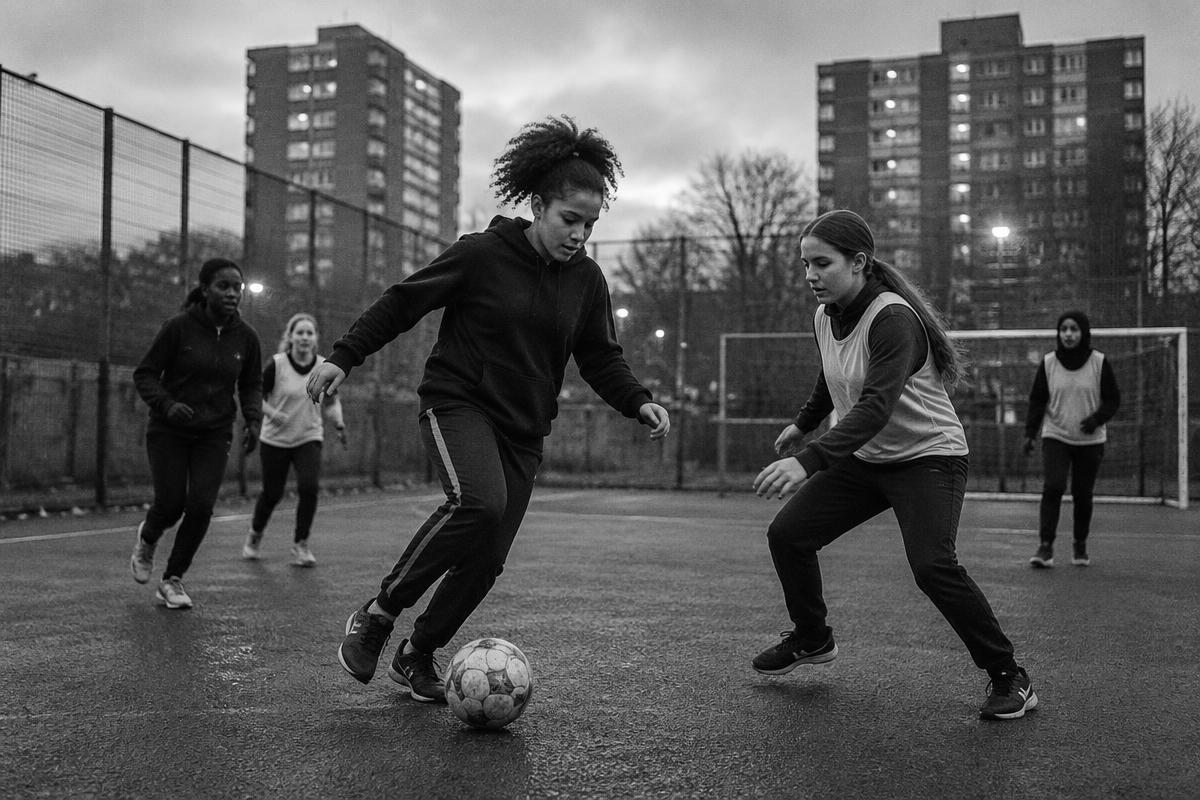
Ball Physics / One Touch / The programme
The invisible intelligence you can learn to see.
One Touch is the hook.
Football is the intervention.
The girls' own words are the outcome.
Football is not only what happens on the ball. It is what players see, anticipate, communicate and influence before the ball arrives.
The challenge / 01
Can you prove it?
01 / Notice
The method
A line or football-intelligence idea makes the concept memorable.
What did you see?
What happens next?
Try it physically.
Why did you make that decision?
Can you find another solution?
Put your football intelligence into words.
My football brain has value.
What can you notice?
What options exist?
What happens next?
Experience the principle yourself.
What did the player see that you didn't?
The invisible intelligence
The most valuable thing on the pitch that nobody can touch.
Move one metre and the game changes.
The decision can begin before the ball arrives.
Make an opponent believe one future while creating another.
A player's body can reveal where she can move next.
The future path of the ball changes at the instant of contact.
Sometimes slowing down creates the opportunity to go faster.
Act on what will happen, not only what has happened.
Make the decision before the ball reaches you.
The journey
Scanning & awareness
One Touch lyric
“You watch the ball, I watch the space.”
What did you see before the ball arrived?
Creating space
One Touch lyric
“I don't find space, I make space.”
Who benefited from your movement?
Seeing what happens next
One Touch lyric
“I saw the corner three moves behind.”
What do you think happens next — and after that?
Deception & off-ball influence
One Touch lyric
“Keeper reads what I let them.”
“Ball says left but it's leaving right.”
Programme line — not a song lyric“I don't need the ball to change the game.”
Can you change an opponent's decision?
Useful information
Programme prompt — not a song lyricWhat information does my teammate need from me?
Words, gestures, movement, eye contact and positioning.
Player voice & ownership
Player-created / programme examplesGirls create their own football-intelligence lines.
Their reading of the game, in their own words.
They stop repeating our language.
They start creating their own.
One prototype session / adaptable to existing football provision
“I don't find space.
I make space.”
One Touch lyric
A 45–60 minute session: 42 minutes of core activities, with 3–18 minutes for warm-up, transitions and further play. Adaptable to existing football provision, this prototype would be refined with coaches and delivery partners, not imposed as coaching doctrine.
Play or introduce the relevant One Touch line.
Show a freeze-frame. Where is the space? Who created it?
Play a small-sided game focused on creating space away from the ball.
Introduce choices or constraints; let players solve the space problem themselves.
What did you see? Who benefited from your movement? What changed when you moved?
Invent one football-intelligence line about what you learned.
Player voice / prototype
What did you notice that nobody else did?
I SAW...
I CHANGED...
I HELPED...
NEXT TIME I...
Player-created / programme examples — not song lyrics
“I don't need the ball to change the game.”
“I knew she'd press, so I played around her.”
“I checked my shoulder before the pass.”
The pilot hypothesis
If girls are given a memorable, enjoyable way to explore the cognitive side of football — and repeated opportunities to make decisions, explain them and hear their peers' ideas — might they become more confident in their ability to understand and influence the game?
That could affect:
We don't know yet.
That's what a pilot is for.
Evaluation / proposed
“I feel confident making decisions when I play football.”
“I notice what other players are doing before I receive the ball.”
“I feel comfortable sharing my ideas about football.”
“I can influence what happens even when I don't have the ball.”
“I feel I have something valuable to contribute.”
“I look forward to football sessions.”
“Tell us about something you saw in a game that you would not have noticed before.”
A pilot could use short pre/post measures, coach observation, participant voice and follow-up. A comparison group could be added with an evaluation partner if useful.
Who it is for
An initial pilot could focus on girls around 12–14 with mixed levels of experience: regular players, occasional players, girls on the edge of participation, and girls who enjoy football but do not yet feel confident joining in.
You don't have to be the fastest, strongest or most technically gifted player to have something valuable to contribute.
Your football brain matters.
An invitation
A coach tests one module.
A six-week pilot across a manageable group.
Co-design the programme and assess what changes.